Best Chinese Learning Apps in 2026: An Honest Comparison
A direct comparison of the best Chinese learning apps in 2026: ratings, strengths, weaknesses, and how to combine them. No fluff.
Most Chinese learning apps are not worth your time. A few are genuinely good, but for specific things. Here is a direct comparison of the ones that matter, followed by brief summaries of each.
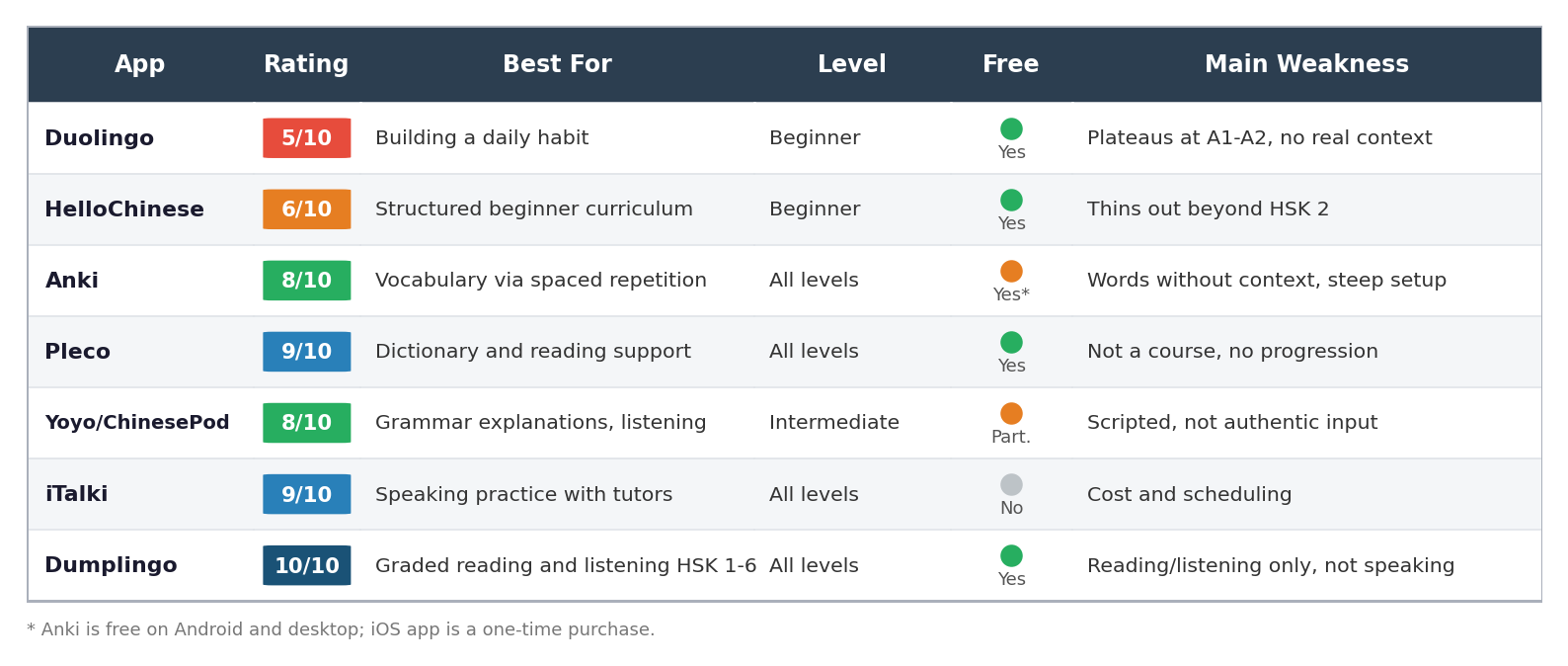
Quick Comparison
Duolingo
5/10. Best for: habit building. The gamification works for forming a daily routine. Coverage of HSK 1-2 vocabulary is passable. The sentences are artificial, there is no extended reading, and most learners plateau at A1-A2 despite long streaks. Use it as a habit anchor only. After the first month it should be a small fraction of your study time.
 5/10. Best for: habit building. The gamification works for forming a daily routine. Coverage of HSK 1-2 vocabulary is passable. The sentences are artificial, there is no extended reading, and most learners plateau at A1-A2 despite long streaks. Use it as a habit anchor only. After the first month it should be a small fraction of your study time.
HelloChinese
6/10. Best for: structured beginner curriculum. Better than Duolingo for Chinese specifically. Clearer grammar explanations, stronger pinyin and tone coverage, and a logical HSK 1-2 sequence. Content thins out beyond HSK 2. Pair it with graded reading from week one and you will progress faster than with either alone.
 6/10. Best for: structured beginner curriculum. Better than Duolingo for Chinese specifically. Clearer grammar explanations, stronger pinyin and tone coverage, and a logical HSK 1-2 sequence. Content thins out beyond HSK 2. Pair it with graded reading from week one and you will progress faster than with either alone.
Anki
8/10. Best for: vocabulary through spaced repetition. Not a language app in the conventional sense, but the most effective vocabulary memorisation tool available. Pre-built HSK decks exist for every level. Anki teaches words as definitions, not as living language, so you still need real reading to make that vocabulary stick. See the guide to using Anki for Chinese to set it up properly.
 8/10. Best for: vocabulary through spaced repetition. Not a language app in the conventional sense, but the most effective vocabulary memorisation tool available. Pre-built HSK decks exist for every level. Anki teaches words as definitions, not as living language, so you still need real reading to make that vocabulary stick. See the guide to
 Pleco
9/10. Best for: dictionary and reading support. Not a course. Essential infrastructure. The free dictionary is comprehensive with audio, stroke order, and example sentences. The paid reader add-on lets you look up any word in any Chinese text instantly. Nothing else comes close for on-demand reference at any level.
 9/10. Best for: dictionary and reading support. Not a course. Essential infrastructure. The free dictionary is comprehensive with audio, stroke order, and example sentences. The paid reader add-on lets you look up any word in any Chinese text instantly. Nothing else comes close for on-demand reference at any level.
Yoyo Chinese and ChinesePod
8/10. Best for: grammar explanations and intermediate listening. Yoyo Chinese grammar videos are among the clearest English-language grammar explanations available. ChinesePod covers a wide range of topics and levels through dialogue-based lessons. Both are supplements, not replacements for reading and listening to real Chinese.
 8/10. Best for: grammar explanations and intermediate listening. Yoyo Chinese grammar videos are among the clearest English-language grammar explanations available. ChinesePod covers a wide range of topics and levels through dialogue-based lessons. Both are supplements, not replacements for reading and listening to real Chinese.
Dumplingo
10/10. Best for: graded reading and listening, HSK 1 to HSK 6. Built around the thing that actually drives acquisition: reading and listening to Chinese you can mostly understand. Stories span all six HSK levels, from the beginner-friendly Huangshan Adventure at HSK 1 through A Busy Weekend at HSK 3 and beyond. Karaoke-sync audio highlights each word as it is spoken, tying character recognition, pinyin, and tone together. Tap any word for an instant definition. Works best alongside Anki for vocabulary and Pleco as a reference.
 10/10. Best for: graded reading and listening, HSK 1 to HSK 6. Built around the thing that actually drives acquisition: reading and listening to Chinese you can mostly understand. Stories span all six HSK levels, from the beginner-friendly
 Speaking Practice
None of the above covers speaking. iTalki connects you with professional tutors and community language partners for video sessions. Even one 30-minute session per week produces real progress that no app can replicate. Speechling provides human pronunciation feedback, useful specifically for tonal accuracy early on. HelloTalk and Tandem are language exchange apps if you want free conversation practice with native speakers.
The Right Combination by Level
Beginner (HSK 1-2): HelloChinese for the first 4-6 weeks, Anki daily (15 min), Dumplingo for reading and listening as soon as you know 80+ words, Pleco as your dictionary throughout.
Intermediate (HSK 3-4): Anki for targeted vocabulary, Dumplingo as the core, Yoyo Chinese for grammar points that come up in reading, Dumplingo's own grammar guide mapped to HSK level.
Advanced (HSK 5-6): Anki for vocabulary gaps, Dumplingo HSK 5-6 stories as a bridge to authentic content, Pleco reader for real texts, then native media as comprehension allows.
A Note on AI Tools
ChatGPT and Claude are genuinely useful for on-demand grammar questions. "Why does this sentence use le?" gets a detailed answer immediately. Use them as a study assistant for grammar questions and example sentences. The actual language acquisition still comes from reading and listening to real Chinese.
Dumplingo is free to start: a growing library of graded Chinese stories from HSK 1 to 6, with karaoke-sync audio and tap-for-definition. Start reading